An interview with Andrey Laptev, choirmaster of SS Peter and Paul Cathedral in Sydney, on the Liturgical Music Conference in Sydney
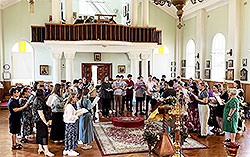 People who attend church for Orthodox Christian services know that the choristers create a special atmosphere and mood in the church. It is no coincidence that since ancient times, the voices of the church choir have symbolized the heavenly singing of angels. We talk with Andrey Laptev, the choir director of SS Peter and Paul Cathedral, about the recently held diocesan Liturgical Music Conference in Sydney. People who attend church for Orthodox Christian services know that the choristers create a special atmosphere and mood in the church. It is no coincidence that since ancient times, the voices of the church choir have symbolized the heavenly singing of angels. We talk with Andrey Laptev, the choir director of SS Peter and Paul Cathedral, about the recently held diocesan Liturgical Music Conference in Sydney.
— How often do such meetings of our church choirs take place?
— The last such choral assembly of our Russian Orthodox Church Outside of Russia's Australia-New Zealand Diocese was held in 2017 in Brisbane. People of different ages and varying musical backgrounds join church choirs. Therefore, such a gathering is a wonderful opportunity to conduct practical and theoretical sessions with them on vocal techniques, conducting, and a number of other subjects. I also gave a lecture for the participants about Dmitry Stepanovich Bortnyansky, a well-known Russian composer of church music. During the days of the assembly, we marked the 200th anniversary of his passing.
About 75 participants from various cities gathered for the meeting, which lasted several days at SS Peter and Paul Cathedral. Many parishes were able to subsidize their singers for this trip, as church choirs are a very important part of parish life.
— Do you think the meeting was successful?
— Very successful, in my opinion. The conference concluded on the evening of Saturday, October 11, 2025, and on the morning of Sunday, October 12, when the choristers, divided into two choirs, participated in full services at the cathedral. A lot of work was done during the preparation; the participants were tired but gained a great amount of necessary knowledge and achieved a lot.
— How do choirs from different parishes perform? Do you try to standardize this process or does much depend on the choir directors?
— At the event, we selected common musical material and learned it together, but I know that in the parishes the melodies are sung slightly differently. We try to convey a general church style to the singers, while the melodies can vary. The goal and idea of a church choir is not only to create an atmosphere, but also to bolster the text of the prayers and lead the parishioners to participate in joint prayer.
— Conventions are held rarely, and in the period between them, do you assist the regents and choirs of other parishes?
— I am the choir director of the cathedral and at the same time a member of the Church Choir Committee, where we try to support other choirs in our diocese. I have long wanted to organize singing workshops—lessons in the parishes. This would be a good expansion of our work. Since we are all volunteers and engaged in our main jobs, it is sometimes difficult to find time for this.
— Are there plans for such events?
— Yes, this will undoubtedly bring considerable benefit. The senior member of our choir committee, Nikolai Kovalenko from Melbourne, members Grigory Scanlan from Brisbane, Olga Leshcheva and I are from Sydney. Fr Andrey Morgan from Blacktown and my wife Nastasya Laptev also participated in organizing the conference. She helped me a lot. For the past two months, I have been very busy with the opera, and she carried out a lot of organizational work.
— It should be noted that Nastassya has a wonderful voice!
— Thank you; during the event she gave vocal lessons to women. Greg Scanlan conducted vocal lessons and sight-reading principles for men choristers. My lessons were dedicated to the basics of conducting, Mother Masha Nekipelov taught lessons on reading Church Slavonic, and Olga Leshcheva conducted classes on learning the eight tones, which is a system of musical modes used in Orthodox liturgical music for classifying chants.
— What's new in your church choir at the cathedral? How many singers participate in Sunday and holiday services?
— It's a mixed choir; we have soprano, alto, tenor, and bass voices. The choir has 30-35 members, mostly women, but there are enough male voices as well. The singers are excellent, professional in their level of performance, which is a great help for the choir director. However, like in any active group, the lineup changes, so training is necessary. I try to teach new chants, you can't stop at what has been achieved. Soon we will start preparing for the upcoming Christmas and Epiphany holidays.
— In which other parishes are there strong large choirs?
— I know there are good choirs at the Holy Protection Church in Cabramatta, in the parish of the Vladimir Mother of God in Rocklea, and a growing choir at St Nicholas Cathedral in Brisbane. I haven’t been to Victoria for a long time, but the Melbourne Cathedral choir has always been known for its good singing. These are probably the largest choirs.
— Do you stay in touch after the confrerence ends?
— I recently sent emails to the choristers thanking them for participating in our meeting. Social networks help keep in touch; we have a group called RO Singers in Australia and New Zealand, where participants can discuss important topics, ask questions, and get explanations. It's a good meeting site.
— I know you are currently preparing to participate in the production of "Eugene Onegin" at the Australian Opera.
— This time, I am not only singing in the chorus but also conducting phonetic training for the participants – diction for the singers. After all, the opera is performed in Russian. Almost all the soloists are of non-Russian origin and do not speak Russian. Since I am a vocalist myself, it is easier for me to work with singers to find the fastest way to correctly sing phrases in Russian. I really enjoy this work. The production was supposed to take place in 2020 but was postponed due to COVID. The performance of this opera is now scheduled for February next year.
— Very interesting, thank you for the story! We wish your plans come true, both in your role as the conductor of the parish choir and at the Australian opera!
Interviewed by Vladimir Kuzmin
|