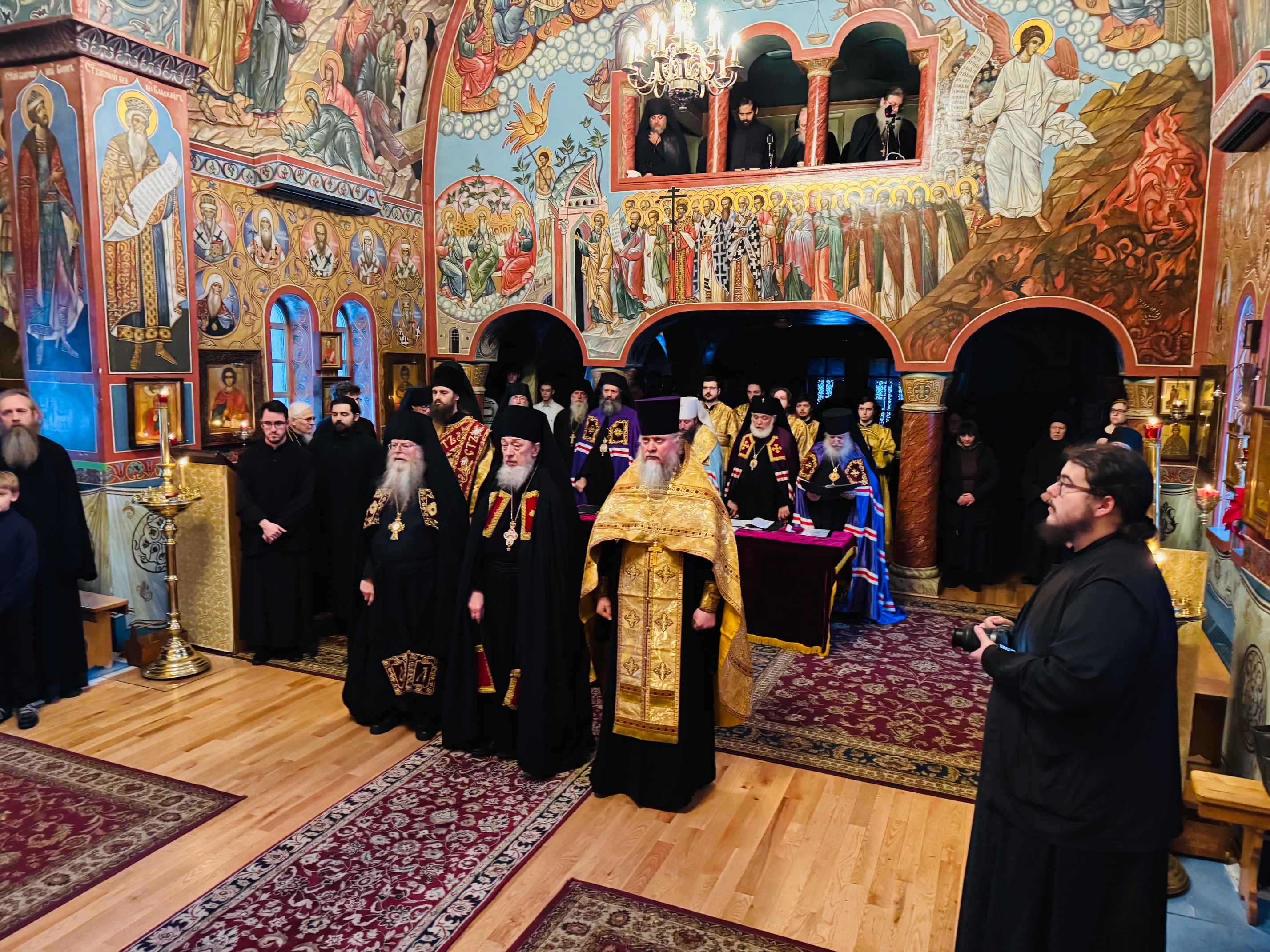
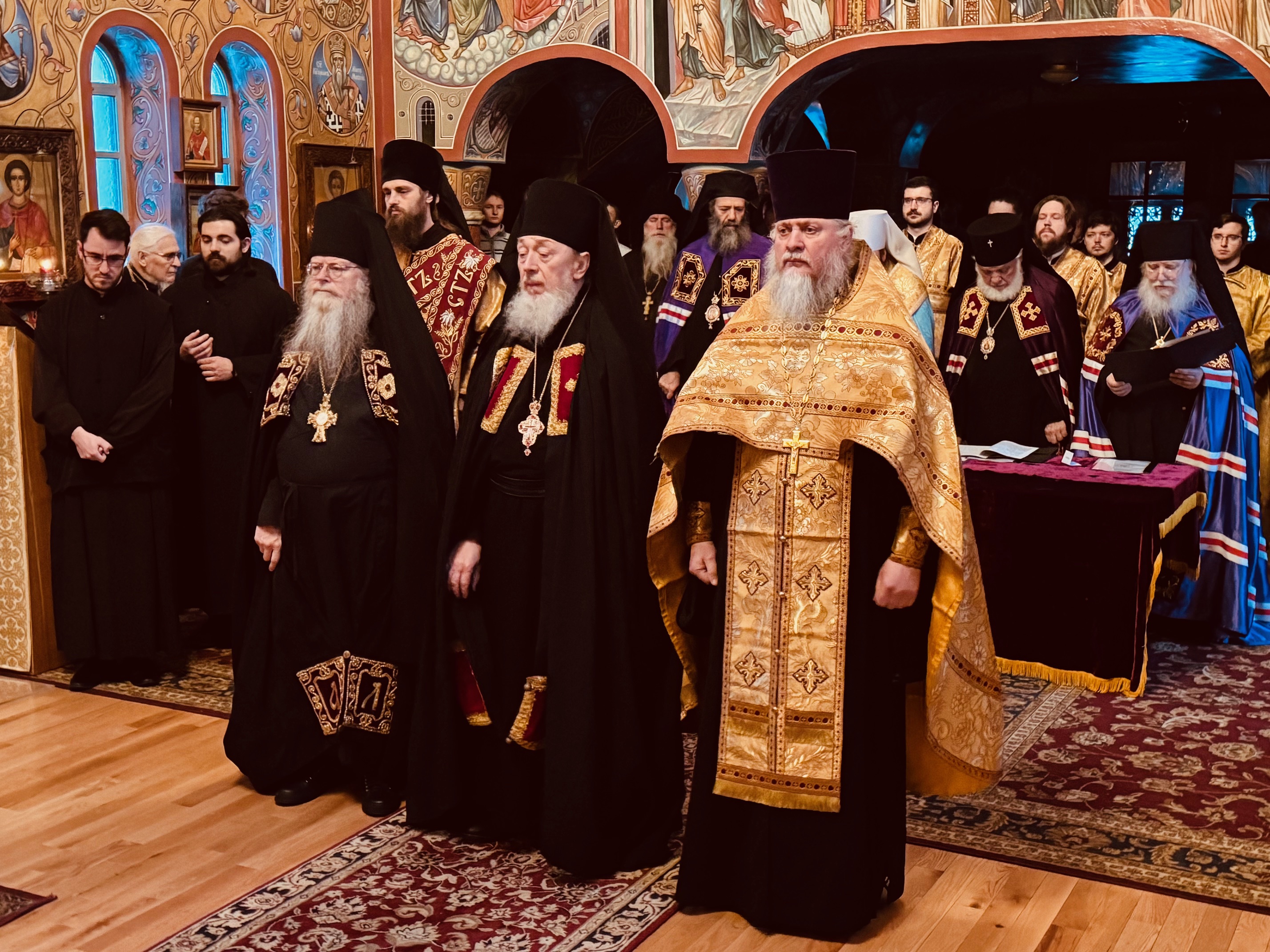
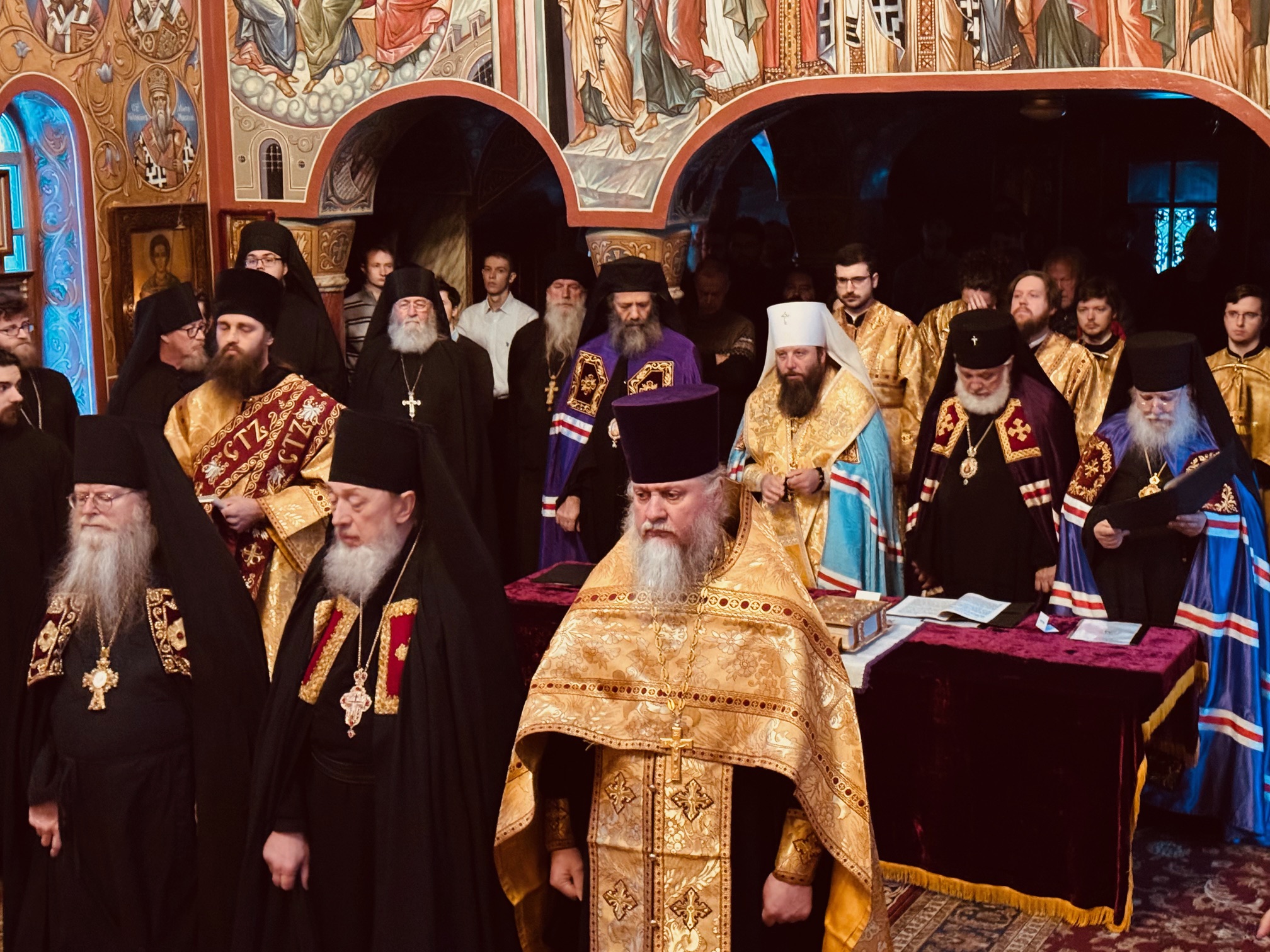
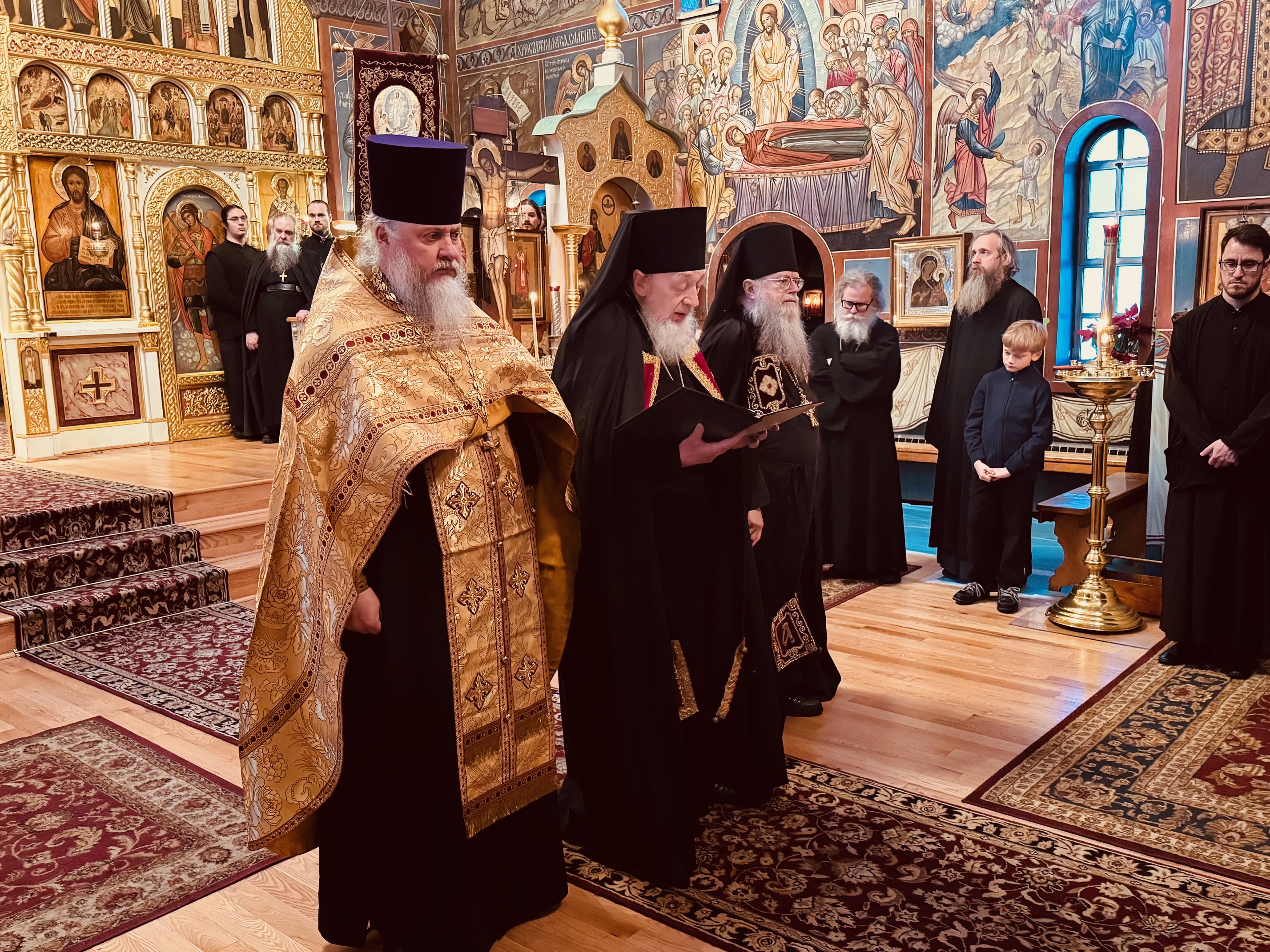
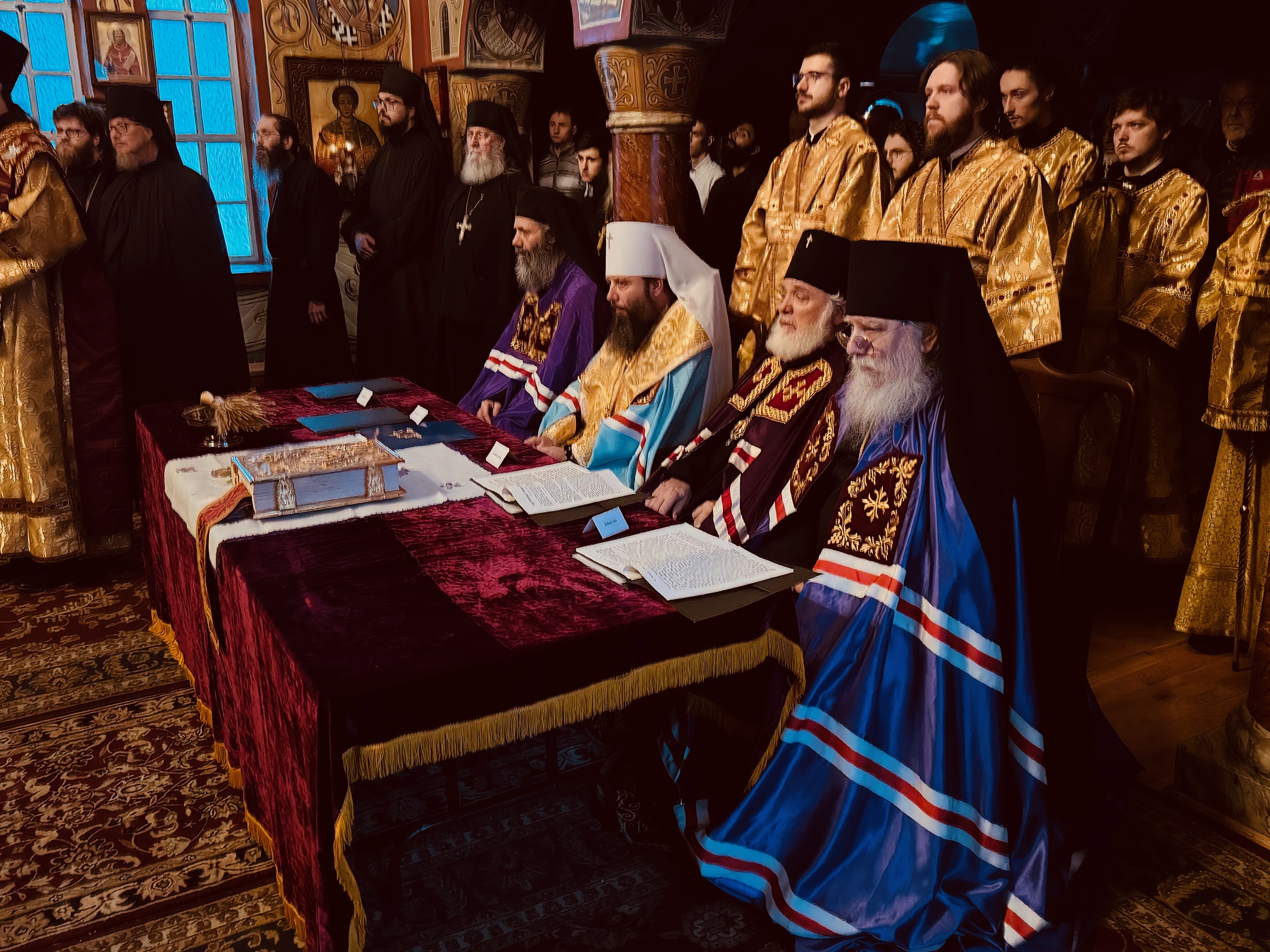
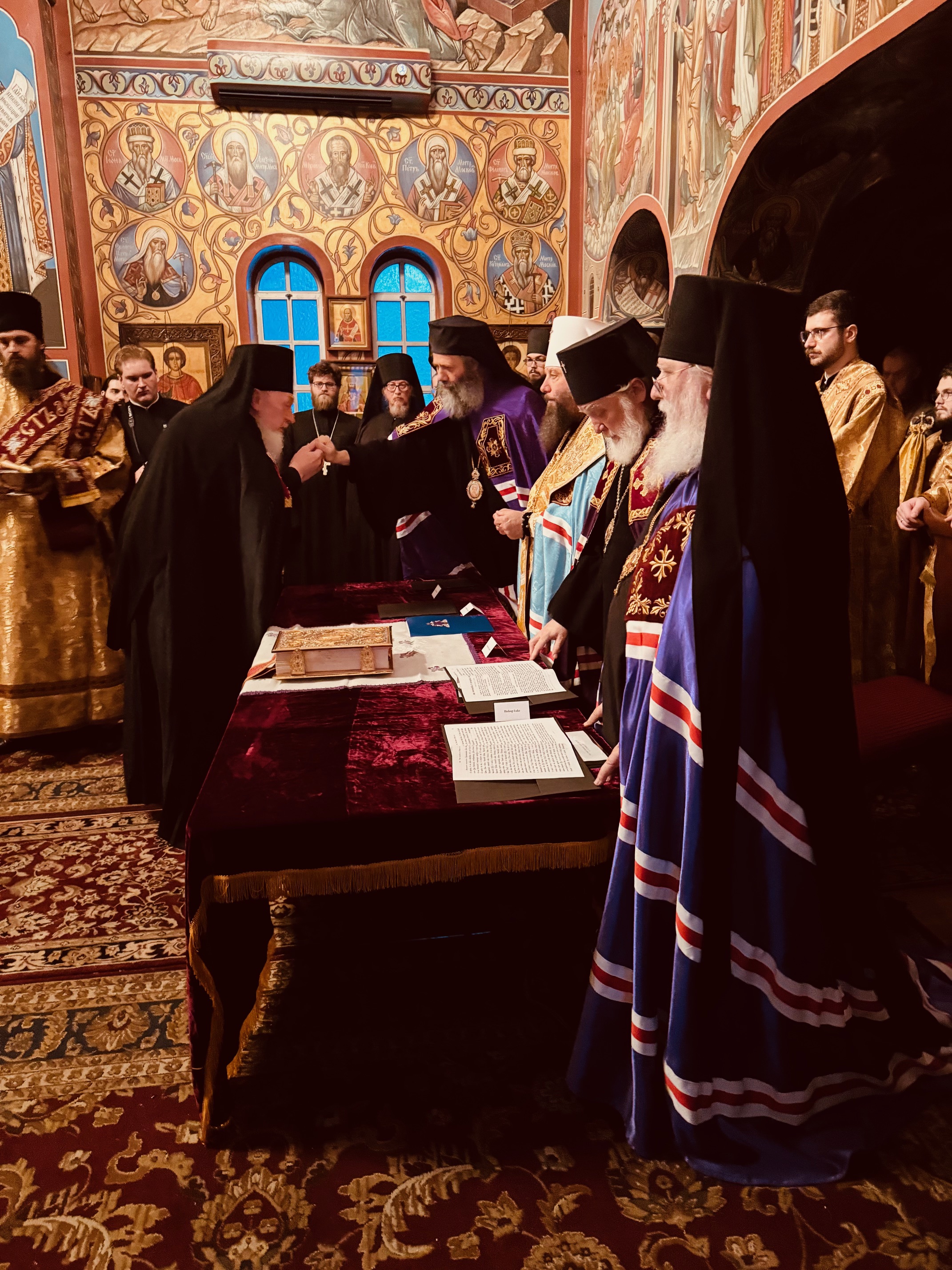
By the will of God and by the decision of the Holy Synod of Bishops of the Russian Orthodox Church Outside of Russia, the rite of the nomination of my unworthy self to episcopal service is now being performed—so that I may be able to bend my shoulders beneath the good yoke of Christ and receive the most exalted and responsible lot of archpastoral grace.
Your Eminences and Your Graces, holy Hierarchs of Christ!
With fear and trepidation I stand before you today, before the lot of this great ministry, “not gainsaying in the least.” The Lord Himself by His love for me, a sinner, and His All Good Providence toward me, the unworthy, moves me to approach this Mystery by awakening in my heart a reciprocal love for my Creator and Provider, and encouraging me to respond in agreement to His sweetest voice calling “Lovest thou Me? Feed My sheep.” (John 21:16).
I understand that the episcopacy is, first and foremost and above all, not power or honor, but a work of labor and spiritual struggle. Being chosen is the mercy of God, yet at the same time a heavy cross. If the Christian life is the bearing of the cross, then episcopal ministry is co crucifixion with Christ. One cannot help but remember the deeply moving words of Saint Mitrophan of Voronezh: “The episcopacy is co crucifixion with Christ upon the Cross, and from the Cross one does not descend.” It is the Cross that I see before me at the very heart of episcopal ministry: the Cross upon which I must crucify my own will and passions, self love and pride, self opinion and self confidence.
Anyone who wishes to become a successor of the Apostles must be prepared to drink the cup that Christ drank, and not think of sitting in glory at His right hand or His left.
I lay my life before your holiness in total and sacrificial dedication to Christ, the Chief Shepherd and Savior of the world. I know my weakness. I know that it is impossible for a man to bear this cross by himself unless the Lord grants him strength and fortitude. Yet in His help, His mercy, and His love I trust and dare to embark upon the path of episcopal ministry, for the grace and prayers of the Russian Orthodox Church Outside of Russia, the prayers of the archpastors of the Holy Synod of Bishops, inspire me and mysteriously lead me toward receiving the special grace of apostolic succession. Blessed Augustine called the Creator “the Most Distant—and the Most Near.” The Most Distant—for created beings; the Most Near—for those who love Him with all their heart and soul, their entire strength and mind. The Most Near—for He has embraced the human race with His love, being Himself Love, extended unto the Incarnation and the Cross—“for us men and for our salvation.”
The greatness of episcopal ministry fills me with awe, for “unto whomsoever much is given, of him shall be much required; and to whom men have committed much, of him they will ask the more” (Luke 12:48). Yet I am consoled by the words of the Lord, spoken before His Ascension to the Apostles—and therefore also to their successors: “I am with you always, even unto the end of the world” (Matthew 28:20). In my human weakness, I feel anxious of the ministry that lies ahead, yet before you, vladykos blessed with godly wisdom, I confess my hope and trust in the grace of God, which “always heals what is infirm and supplies what is lacking”.
Now as I see my entire life in my mind’s eye, I, above all, offer praise to God, the Creator of all that is good, Who, caring for and establishing His beloved inheritance, the Holy Church (Rite of the Triumph of Orthodoxy), has granted me a chance to be a part of it since my childhood and have the opportunity to attend the divine services in the Holy Trinity–St. Sergius Lavra. Many times I have experienced the patience of God, and being guided by His teachings, I have come to understand that nothing happens by chance; all is governed by the Lord, Who guides one to salvation through various paths, as the Holy Prophet David the Psalmist says, “The steps of a good man are ordered by the Lord” (Ps. 36:23).
My soul is filled with gratitude to the Most Holy Theotokos, whose protection I have always felt and continue to feel throughout my life.
On this sacred day there is a good tradition for the candidate to remember with kind words those who are dear to him and who have played a significant role in his life and in shaping him. I too want to follow this tradition, for my heart is filled with love, respect, and gratitude toward these people.
I am grateful to my parents. They raised me and taught me moral principles not only through words but also by the example of their hardworking life, their sincere love, humility, and patient endurance of sorrows.
Recalling the words of the Apostle Paul, “Remember them which have the rule over you” (Heb. 13:7), I wish to express my gratitude and prayerfully remember my spiritual mentors and teachers. Their sacrificial service to the Church and their sincere devotion to the work of the Gospel has always inspired me in my labors. One of them was Archimandrite Naum (Baiborodin), a monk of the Holy Trinity–St. Sergius Lavra, who is no longer with us. I took my first steps on the path of my spiritual development. Through my conversations with him I first began to think about monasticism, and although at that time I had not yet fully understood or embraced the monastic life, even then, deep within, I felt that this was what my soul desired and sought, and that the Lord, through His love for me, was leading me toward spiritual growth, the knowledge of truth, and union with Him.
Upon my arrival in Canada, in the Holy Trinity Cathedral in Montreal, His Eminence Archbishop Gabriel of Montreal and Canada turned his archpastoral attention toward me, choosing me as his subdeacon, and later ordaining me to the diaconate and priesthood. Under his attentive archpastoral care and guidance I grew first as a subdeacon and then as a clergyman, and in him I always found fatherly concern.
I thank the Lord that in 2009 He led me to the Holy Trinity Monastery, our ‘Lavra Abroad,’ where I always received the spiritual support I needed, and where I was ordained to the priesthood and, with the blessing of Archbishop Gabriel, tonsured by Bishop Luke of Syracuse into the lesser schema with the name Spyridon, in honor of St. Spyridon of Trimythous. I am deeply grateful to the instructors of our Holy Trinity Seminary, who introduced me to the mysterious and consoling world of theology. And it so happens that my consecration is taking place on the Feast of the Three Great Ecumenical Teachers and Hierarchs—Basil the Great, Gregory the Theologian, and John Chrysostom—who are the heavenly patrons of our seminary.
I thank His Eminence Metropolitan Nicholas and all the archpastors of our Church, who have entrusted me with such great honor and appointed me to the great archpastoral service in the Church of Christ.
With gratitude, I address His Holiness Patriarch Kirill of Moscow and All Russia and the Holy Synod of Bishops of the Russian Orthodox Church for approving the decision of the Holy Synod of Bishops of the Russian Church Abroad regarding my election as bishop.
A bishop is the shepherd of his flock, their guardian and guide into the Kingdom of God. The words of the Apostle Peter remain relevant today: “Feed the flock of God which is among you, taking the oversight thereof, not by constraint, but willingly; not for filthy lucre, but of a ready mind; neither as being lords over God’s heritage, but being examples to the flock” (1 Peter 5:2–3). The service of a bishop is noble and responsible; it requires one’s complete dedication, full exertion of spiritual strength, and a constant pursuit of moral perfection. A bishop must hold “the mystery of the faith in a pure conscience” (1 Tim. 3:9); his way of life must be consistent with the doctrine he preaches, and his conscience must be clear of anything that might hinder God’s divine grace acting through him. St. Isidore of Pelusium said, “A bishop must be adorned with every virtue, and must regard the misfortunes of others as his own; he lives not for himself but for those entrusted to him, and his life is examined by thousands of eyes and tongues.”
I thank the archpastors present here, who have left their beneficial and manifold labors for the glory of Christ and His Holy Church, which He obtained through His Precious Blood, and who, “as the apostles from the ends of the earth, gathered here,” have come to participate in my Pentecost. I ask for your blessing for the feat that lies ahead, I beg you not to abandon me in your prayers as the least among the brethren, who has resolved to take upon himself the yoke of archpastoral service, accepting with humility the high honor of the episcopacy to which I am now called to by the Holy Spirit through the election of Your Eminence and the Synod of Bishops.
“At these words I hold but one thing in mind and heart: let the will of God be done!”—thus concluded Saint Theophan the Recluse; and I, the unworthy one, repeat these words.
My soul is troubled at this moment, and the importance of my future service overwhelms my mind. Yet I am moved by the words of our Lord Jesus Christ “Ye have not chosen me, but I have chosen you, and ordained you, that ye should go and bring forth fruit, and that your fruit should remain: that whatsoever ye shall ask of the Father in my name, he may give it you.”(John 15:16).
The importance of episcopal ministry is, above all, the biggest responsibility before God for the flock, the enlightenment of their souls with the light of the Gospel, and their growth in Christian virtues. Saint John Chrysostom reminds us of this, saying that “he who has received the episcopacy, as much as he has ascended to a higher degree, so much stricter an account will he give.” (St. John Chrysostom, Homily on the Parable of the Servant Who Owed Ten Thousand Talents and Demanded a Hundred Denarii (Matt. 18:23–35). I bear this in mind and recognize the full seriousness of my new ministry. I dare to believe that the Lord, Who has called me to this new, important, and responsible ministry, will, in answer to your prayers, holy hierarchs of God, strengthen me and make me worthy to be “a workman that needeth not to be ashamed, rightly dividing the word of truth” (2 Tim. 2:15).
I praise the God glorified in the Trinity for all the mercies bestowed upon me, the unworthy, in past years—for all the instructions and consolations that strengthen me in the feat of the service that lies ahead. And I wish to say with the Apostle Paul, “I can do all things through Christ which strengtheneth me.” (Phil. 4:13). I place all my hope in the Lord and believe that the grace of the consecration will strengthen me in my future archpastoral service.
I ask and entreat You, Your Eminences and Your Graces, archpastors, blessed with godly wisdom, to pray for me so that the Lord may grant me, through the Mystery of Consecration, the divine grace and strength that “is made perfect in weakness” (2 Cor. 12:9), that this grace may strengthen me for the feat ahead, and that my future ministry may serve for my salvation and for the salvation of the flock entrusted to my care, unto the attainment of eternal life in the Heavenly Kingdom.
Amen.